

Do you open the Bible only to find yourself scrolling TikTok 15 minutes later? The problem isn't Scripture, it's how you've been taught to read it. Discover three active, thematic reading methods that transform Bible study from a dry, works-based obligation into a life-changing conversation with God.
Deepen Your Understanding 📚
Explore this article interactively with MyBibleIQ's NotebookLM Studio. Listen to an AI-generated podcast version, view interactive slides, or chat with the content to ask follow-up questions about Bible reading methods.
[Launch Interactive Experience]
Why the Bible Feels Dead (And It's Not the Bible's Fault)
You've probably tried. Opened the Bible with genuine intention, sat down with a cup of coffee, and about fifteen minutes later found yourself scrolling TikTok instead.
Or you made it through Genesis with enthusiasm, hit Leviticus, and thought, "How is ancient genealogy supposed to change my life?"
You're not alone. In fact, one of the most common reasons people abandon Bible reading is this exact frustration. But here's what nobody tells you: The Bible isn't the problem. Your reading method is.
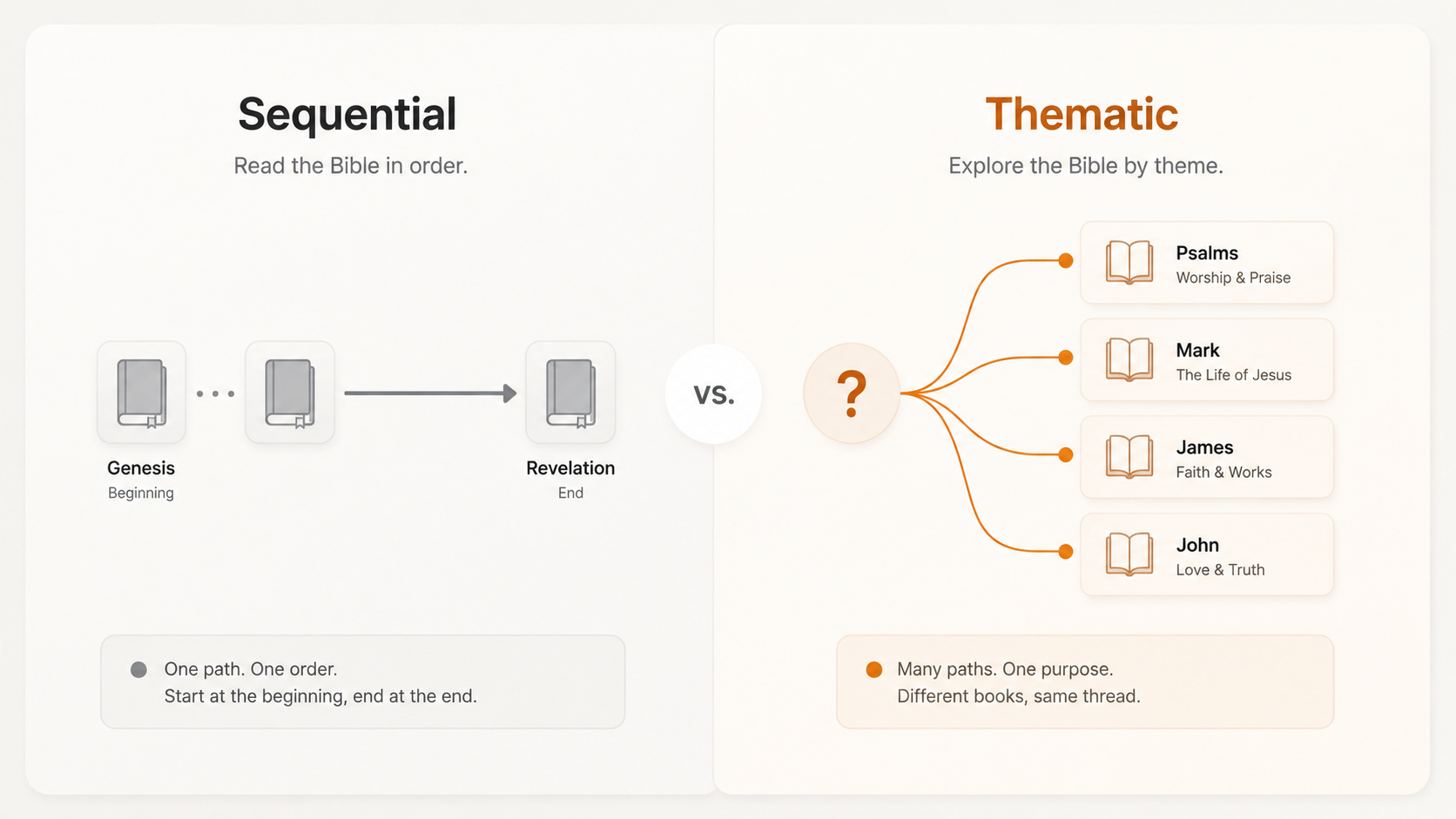
Most people who struggle with Bible literacy approach Scripture the way they'd read a novel, start at the beginning, work through sequentially, hope it makes sense. But MyBibleIQ was built on a fundamental insight: the Bible isn't written like that. It's a library of 66 books, written across 1,500 years, by different authors, in different genres, to different audiences.
Why do people find the Bible boring?
The primary reason isn't the content, it's the reading approach. Reading the Bible sequentially from start to finish is like trying to read an encyclopedia as a novel. The Bible requires intentional, thematic reading to come alive. Most people have never been taught how to read Scripture effectively.
Reading the Bible linearly is like buying an encyclopedia and wondering why it's not as engaging as a novel. The frustration isn't evidence that the Bible doesn't work. It's evidence that you need a different approach.

The Real Problem: Nobody Taught You How to Read Scripture
Think about your education:
In middle school, you learned how to read a novel (theme, plot, character arc). In high school, you learned how to read poetry (metaphor, symbolism, meter). In college, you learned how to read academic papers (thesis, evidence, counterargument).
But nobody ever taught you how to read Scripture.
So you defaulted to the only method you knew: linear reading. Start to finish. And that doesn't work because the Bible isn't designed for sequential reading.
What is biblical literacy, exactly?
Biblical literacy is the ability to understand Scripture in its historical, cultural, and theological context, and more importantly, to let it speak into your actual life. It's not about memorizing Bible facts or passing trivia tests. It's about building a deeper relationship with God through intentional engagement with His Word.
Here's what Bible scholars and serious disciples know: The Bible teaches best when you read it thematically, not chronologically. You don't pray your way from Genesis to Revelation. You pick a question, "What does God say about faith?" or "How do I handle doubt?", and follow that thread through Scripture.
You read multiple genres. You read stories alongside poetry alongside letters. You see how a theme develops over thousands of years. You notice patterns. You encounter God's character, not through abstract theology, but through how He actually shows up for His people across time.
That's the difference between the Bible feeling dead and the Bible actually changing your life.
2 Timothy 2:15 (NASB): "Be diligent to present yourself approved to God as a workman who does not need to be ashamed, accurately handling the word of truth."
Three Reading Methods That Actually Transform Your Bible Study
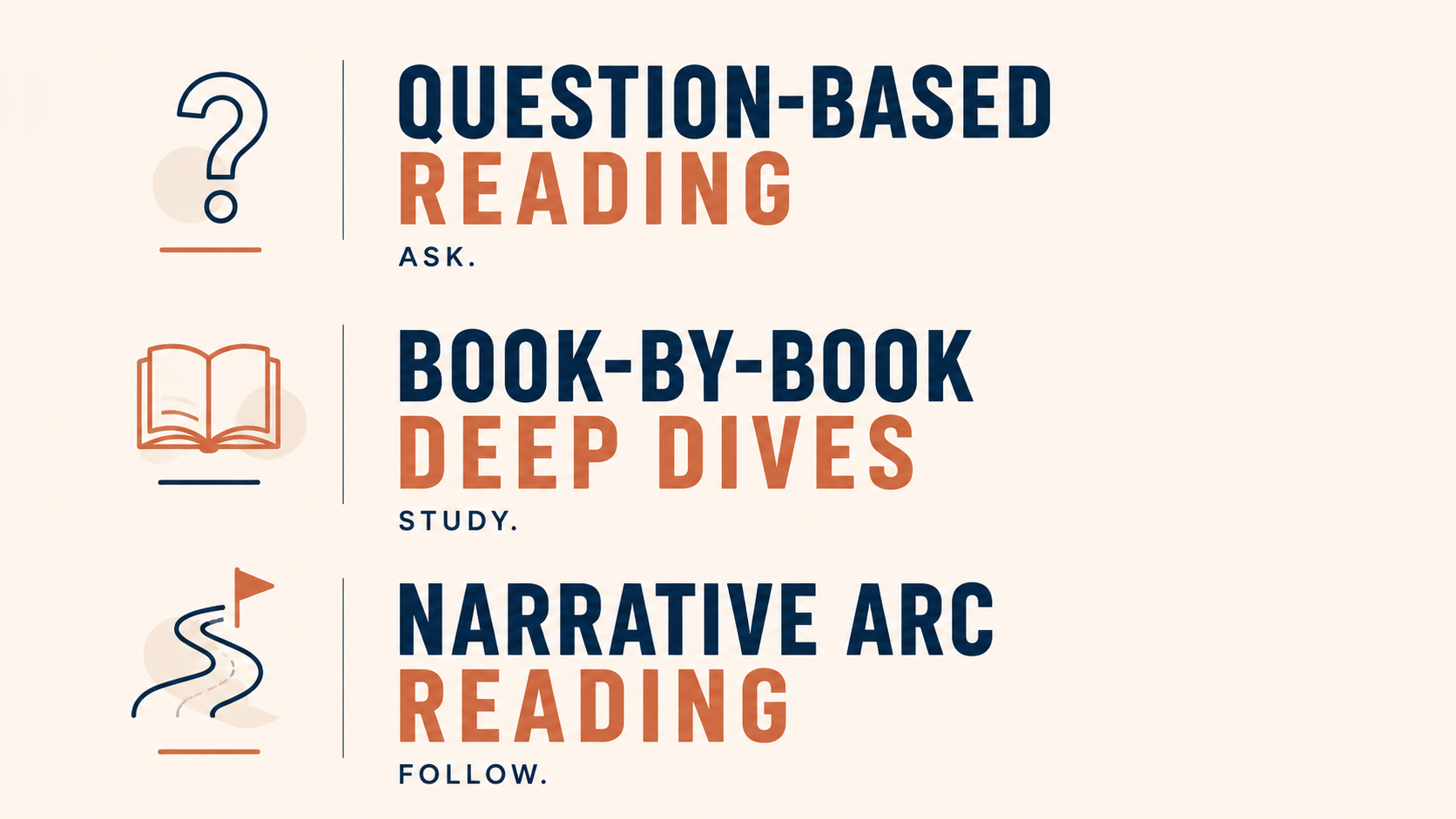
MyBibleIQ's gamified Bible learning approach is built on these three core reading methods. Each one works differently, and each one unlocks Scripture in a unique way.
Method 1: Question-Based Reading
Start with a real question you actually have. Not "What does the Bible say?" (too vague). But:
- "How do I handle anxiety?"
- "What does God want from my career?"
- "Is it okay to question my faith?"
- "How do I know if God exists?"
Then use a Bible app (YouVersion, Logos, Bible Gateway) to search by keyword. Find passages that address your question. Read the passages. Read the context around each one. Notice how different biblical authors approach the same theme differently.
This grounds Scripture in your actual life instead of treating it like homework.
How do I know which Bible reading method to start with?
If you have a specific life question or struggle, start with Question-Based Reading. It's the most personally relevant. If you want to understand one author's full message, choose Book-by-Book Deep Dives. If you want to see God's big-picture redemptive story, begin with Narrative Arc Reading.
Real Example: Wrestling with Doubt
You're struggling with doubt. Search "doubt" in a Bible app. Read what surfaces:
Mark 9:17-27 (NASB): A father admits his doubt to Jesus, asking for help with his possessed child. Jesus doesn't shame him. He heals the boy anyway. Message: Doubt doesn't disqualify you.
James 1:6-8 (NASB): "But when you ask, you must believe and not doubt." This sounds harsh until you keep reading... and realize it's about not being spiritually wishy-washy, not about questioning your existing faith. Message: Doubt is natural; wavering is the problem.
John 20:24-29 (NASB): "Doubting Thomas" literally touches the risen Jesus and says, "My Lord and my God." He has the most concrete faith *after* his doubt. Message: Doubt can lead to deeper faith.
You just went from "the Bible doesn't address my struggle" to "the Bible has way more nuance about doubt than I realized." And suddenly it's not theory. It's your life.
Method 2: Book-by-Book Deep Dives
Instead of jumping around, commit to reading one book intensively. Pick something short first. Not Genesis. Start with:
- A Gospel (Matthew, Mark, Luke, or John)
- A short letter (1 John, Philippians, Colossians, 1 Thessalonians)
- A short narrative (Ruth, Jonah, Esther)
First Pass (Quick Read):
Read it all the way through in 2–3 sittings. Don't stop to study every word. Just read it like a book. Notice the flow. Notice what themes keep appearing. Notice how the author speaks to his audience.
How long does it take to finish one book of the Bible?
A short book like Philippians or 1 John takes about 15-30 minutes to read start to finish. A Gospel takes 1-2 hours. The goal of your first pass is not to study deeply, but to absorb the author's voice and overall message. Treat it like reading a letter from someone you care about.
Second Pass (Deep Study):
Go back and read it again, this time slowly. Make notes. Look up words you don't understand. Read a study Bible that has commentary. Ask questions: Why did the author write this? What was happening culturally? How does this connect to other Scripture?
Why This Works:
You're not jumping between 66 different books. You're sitting with one author's voice. You're starting to think the way they think. And suddenly, Scripture isn't abstract, it's a real person trying to tell you something real about God.
This is the core principle behind MyBibleIQ's Quest system, each quest is a deep dive into a specific biblical story or character, helping you build familiarity and relationship with Scripture.
Method 3: Narrative Arc Reading
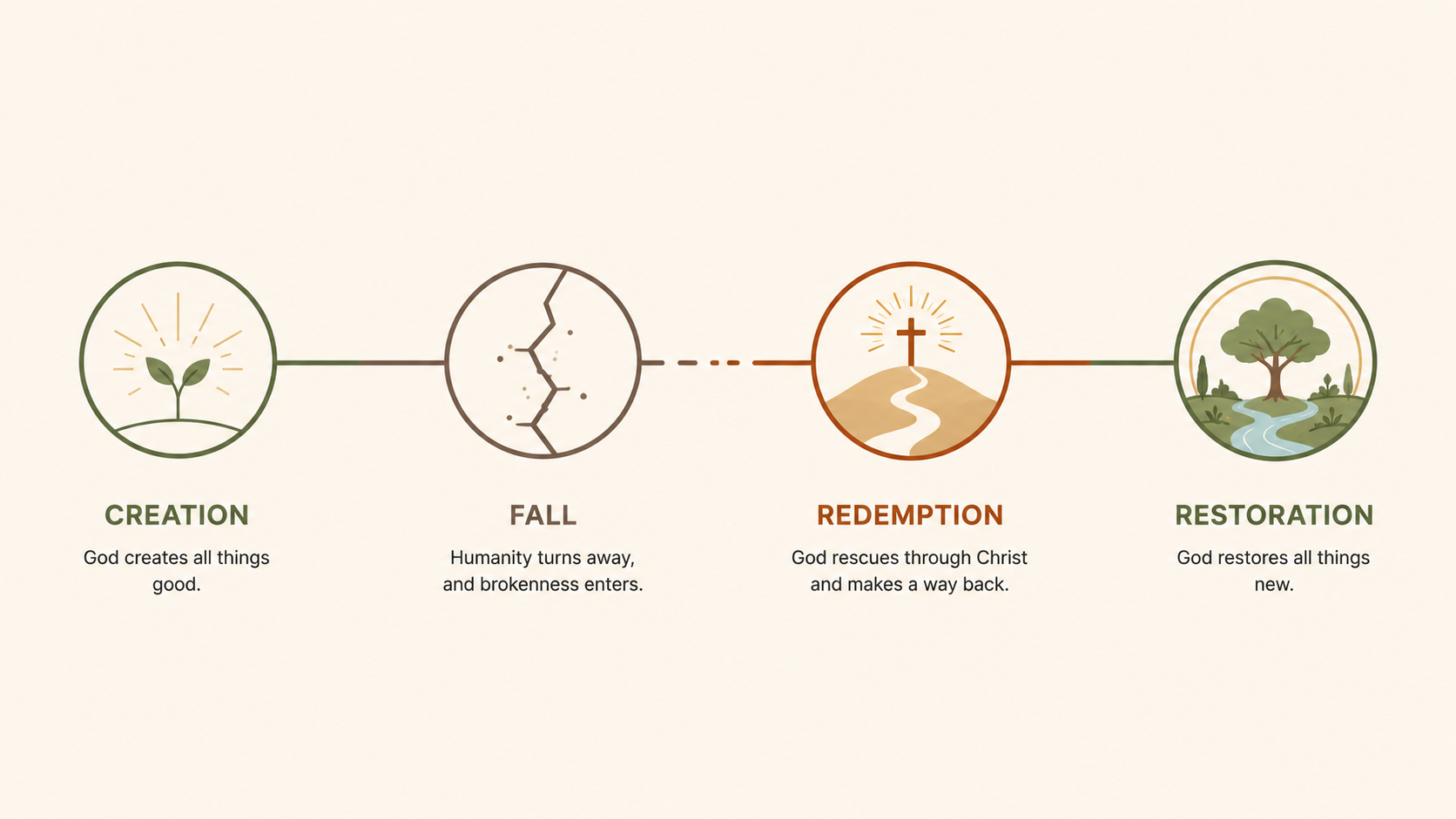
This one's for when you want the big picture. The Bible has a story:
Creation → Fall → Redemption → Restoration
But most people never see the arc because they're too busy being frustrated with genealogies and ancient laws.
Instead, read the major narrative passages in order:
- Genesis 1–2 (Creation)
- Genesis 3 (The Fall, why everything is broken)
- Abraham's story (Redemption begins)
- Exodus (God rescues His people)
- The Gospels (Jesus enters the story)
- Revelation (Restoration, the broken world made new)
Skip the genealogies. Skip the obscure laws. Stick with the story. On your first pass, just follow the plot. You'll see the arc of God's redemption play out over 1,500 years.
Is there a best order to read the Bible?
There's no "wrong" order, but there are intentional orders. Sequential reading (Genesis to Revelation) is rarely best for first-time readers. Most Bible experts recommend either (1) starting with a single Gospel, (2) reading by theme/question, or (3) following the narrative arc. MyBibleIQ's interactive quizzes help you absorb content regardless of reading order.
That's when the Bible stops feeling like homework and starts feeling like the story you're living in. You start recognizing yourself. You start seeing how God shows up for broken people. And you start understanding why millions of people across millennia have risked everything for this book.
The Shift That Changes Everything: From Obligation to Invitation
Here's what changes when you shift your reading method:
You stop reading the Bible because you're supposed to. Instead, you start reading because you want answers to real questions. You stop treating it like a chore. You start treating it like a conversation with someone who actually knows what you're going through.
What if I've never read the Bible before, where do I even start?
Start with the Gospel of Mark (the shortest, most action-packed Gospel). Read it straight through in 1–2 sittings without worrying about understanding everything. Just let the story of Jesus wash over you. Then go back and ask questions. This removes the pressure of "doing it right" and focuses on encountering God's story first.
That's when Scripture becomes alive. That's when you understand why this book has shaped civilizations and changed individual hearts. Not because it's boring. Because it's the opposite.
And this is exactly why MyBibleIQ gamifies Bible learning, because interactive, engaging, interactive practice isn't about making Scripture trendy. It's about removing barriers so you can actually encounter it. So you can read, remember, wrestle with, and be transformed by God's Word.
Psalm 119:105 (NASB): "Your word is a lamp to my feet and a light to my path."
From Head Knowledge to Heart Transformation
The truth is: Bible literacy isn't optional for anyone who wants to follow Jesus. It's not advanced theology for church staff. It's foundational discipleship.
What's the difference between knowing the Bible and knowing God?
Knowing the Bible means understanding content, stories, verses, theology. Knowing God means having a relationship with Him through that content. You can know Bible facts and still feel disconnected from God. But when you know Scripture and let it shape your understanding of God's character, your entire life changes.
But here's what holds people back: We're never taught how to read it. So we try once, get frustrated, and give up. We think the problem is us.
It's not. It's the method.
This is why these three reading methods matter so much. They're not academic techniques. They're bridges that help you encounter Scripture in ways that actually work for your brain and your life.
Your Next Step: Pick One Method and Start This Week
Don't try all three at once. Pick one:
- If you have a pressing life question: Go with Question-Based Reading. Search it. Find what Scripture says. Let it speak to you.
- If you want to develop real familiarity with Scripture: Pick a short book and do a Book-by-Book Deep Dive. Spend a week or two with it.
- If you want to see God's big redemptive story: Follow the Narrative Arc. See how it all connects.
The Bible doesn't need better marketing. It doesn't need to be rewritten for modern audiences. It needs to be read the way it was meant to be read: with intention, with your real questions in mind, with an open heart.
Try it this week. See what happens when you stop approaching Scripture like an obligation and start approaching it like a conversation with the God who made you.
You might be surprised.
The Bible isn't boring. You've just been reading it wrong.
Ready to transform your Bible learning?
Join the MyBibleIQ Waitlist for Early Access
Frequently Asked Questions About Bible Reading
What if I don't have time to read the whole Bible?
You don't need to read the whole Bible at once. Start with one book, maybe a short Gospel like Mark (takes 1-2 hours). Or use Question-Based Reading to engage with Scripture for 15-20 minutes a day focused on what you actually need. Quality engagement beats quantity.
Should I use a Bible study guide or app?
Yes. Apps like YouVersion, Logos, and Bible Gateway let you search by keyword, access different translations, and read commentary. MyBibleIQ's interactive quizzes and flashcards add another layer, they help you retain and test your understanding of what you've read, turning passive reading into active learning.
What if I come across something in the Bible I don't understand or disagree with?
Write it down. Look it up in multiple translations. Read the context. Read commentary. Talk to someone you trust. The Bible welcomes honest questions, some of the most faithful people in Scripture wrestled with God. Don't avoid hard passages; engage them.
How do I know which Bible translation to use?
Most Bible scholars recommend reading the NASB or ESV for study (word-for-word accuracy), NIV for balance, and versions like The Message or NCV for readability. Don't get stuck on "the perfect translation", start reading in whatever version is most accessible to you.
Can I really change my relationship with God just by reading the Bible differently?
Yes, when reading shifts from obligation to genuine engagement, it opens space for God's Spirit to work. You're no longer white-knuckling through a checklist; you're actually listening. That openness is transformative.
How does MyBibleIQ help with Bible literacy?
MyBibleIQ is a gamified Bible learning platform that makes biblical engagement interactive and memorable. Through interactive quizzes, flashcards, and quest-based learning, you build biblical literacy while actually enjoying the process. It supports all three reading methods, Question-Based, Book-by-Book, and Narrative Arc, by giving you a structure for learning and retention.